
What this chapter covers
- The legislative branch of the U.S. government.
- The House of Representatives.
- The Senate.
- The process for making federal laws.
Congress makes federal laws
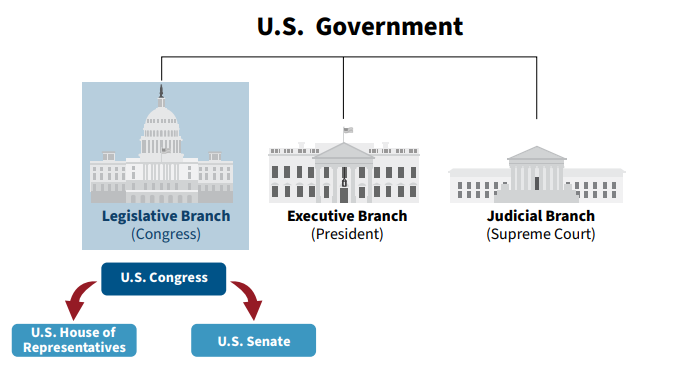
The legislative branch is one branch of the U.S. government. Another name for the legislative branch is the U.S. Congress.
The Constitution says that Congress makes federal laws. When the Founders were writing the Constitution, they believed that the power to make laws is the most important power in government. This is why the first section of the Constitution describes Congress and the power to make federal laws.
Two chambers, one compromise
During the Constitutional Convention, the Founders agreed that the people who make laws should represent the states or parts of states where they lived.
They did not agree on how many representatives each state should have. Some thought the number should be based on how many people lived in the state. Others thought each state should have the same number of representatives, no matter how many people lived there.
They reached a compromise with two parts to Congress: the House of Representatives and the Senate. States with more people have more representatives in the House, while every state has two U.S. senators.
The House of Representatives
There are 435 voting members in the House of Representatives. Each state is divided into congressional districts, and each district elects one person to serve in the House.
Some states have more representatives than others because they have more people. For example, California has the most people and 52 voting members, while Wyoming has the fewest people and one voting member.
Members of the House are elected every two years. To be elected, a person must be at least 25 years old, live in the state where the congressional district is located, and be a U.S. citizen.
The leader of the House is called the Speaker of the House. You can look up your representative at house.gov and the current Speaker at speaker.gov.
The Senate
There are 100 U.S. senators. Each state has two, and senators represent all the people of their state, not just one district.
Senators are elected for six years. To be elected, a person must be at least 30 years old, live in the state they represent, and be a U.S. citizen.
You can look up your state’s senators at senate.gov.
Washington, D.C., does not have any senators because it is not a U.S. state. Washington, D.C., residents should answer that D.C. does not have a senator.
The House and the Senate side by side
| House of Representatives | Senate |
|---|---|
| 435 voting members | 100 senators |
| Seats depend on each state’s population | Each state has two senators |
| Members represent a congressional district | Senators represent all the people of a state |
| Two-year terms | Six-year terms |
How a bill becomes a law
A law is another word for a rule that people must follow. A federal law is a rule that everyone in the United States must follow.
When members of Congress want to make a new law, they write a bill. A bill is a proposal for a new law.
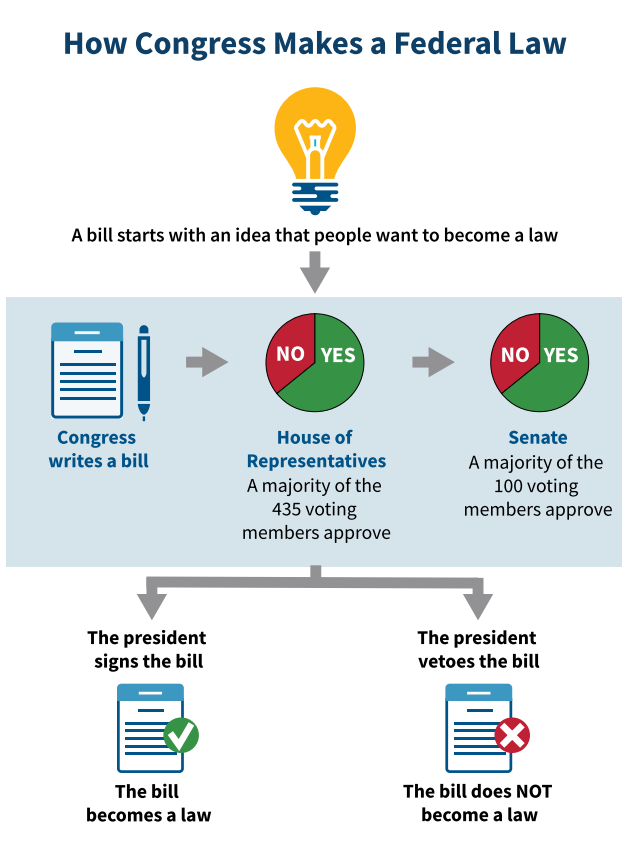
For Congress to pass a bill, a majority of both the House and the Senate must vote for it. In the House, that means 218 of the 435 voting members must vote in favor. In the Senate, most bills need 51 senators, or a majority of those voting and present.
If both parts of Congress pass the bill, it is sent to the President. If the President agrees, the President signs the bill into law. If the President does not agree, the President vetoes the bill, which means the bill does not become law unless Congress votes to override the veto.

What to remember
- Congress is the legislative branch, and it makes federal laws.
- Congress has two parts: the House of Representatives and the Senate.
- The House has 435 voting members elected every two years from congressional districts.
- The Senate has 100 members, two from each state, elected for six years.
- A bill needs a majority in both chambers and the President’s signature to become law.
- A veto can be overridden by Congress.